


Money Transfer Limits to India from Europe: Rules Explained (2026)
 Panda AI
Transfer limits to India from Europe are often misunderstood. India received over $135 billion in remittances in FY 2024–25, with a significant share coming from countries like Germany, France, the Netherlands, and Spain.
For most NRIs, there is no hard upper limit on how much you can send. What matters is understanding the compliance rules on both sides, including EU AML requirements and India’s FEMA regulations. This guide explains everything you need to send money smoothly and legally.
Is There a Legal Limit on How Much You Can Send to India from Europe?
There is no fixed legal ceiling on personal remittances from European countries to India for most purposes. You can, in principle, send €500 or €500,000 — but the larger the amount, the more documentation, identity verification, and compliance checks will apply on both sides.
The key principle across all EU countries is this: any transfer operator must comply with Anti-Money Laundering (AML) rules, which means identifying senders and verifying the source of funds, especially for larger amounts. On India’s side, all incoming foreign transfers must comply with the Foreign Exchange Management Act (FEMA), enforced by the Reserve Bank of India (RBI). If you’re curious how the rules differ for the US corridor, here’s a breakdown of transfer limits and IRS reporting rules from the USA.
Understanding both sides makes the process straightforward, even for large transfers.
India-Side Rules for Transfers: FEMA Explained for European NRIs
Every rupee arriving in India from abroad is governed by FEMA (Foreign Exchange Management Act, 1999). These rules determine how money must enter India, how it is classified, and what compliance steps you need to follow.
Transfers Must Use Authorized Channels
All money sent to India must go through an RBI-authorized Authorized Dealer (AD) Category-I bank or a licensed remittance partner. This ensures the transfer is legally compliant.
Using informal or unregulated channels can lead to penalties under FEMA Section 13, which can be as high as three times the transfer amount.
Purpose Code Is Mandatory
Every inward remittance must include an RBI purpose code that explains why the money is being sent. This code is attached by the receiving bank and reported to the RBI.
Common purpose codes include:
- P0001 for family maintenance
- P1306 for gifts
- P0010 for education
Using the wrong code can delay your transfer or trigger compliance checks.
Practical Limits Based on Purpose
There is no fixed upper limit on how much money you can receive in India under FEMA. However, limits and tax implications vary depending on the purpose of the transfer.
- Family maintenance and living expenses: No cap, not taxable
- Gift to a relative: No cap, fully tax-exempt
- Gift to a non-relative: No cap, but amounts above ₹50,000 per year are taxable.
- Education payments: No cap, requires correct purpose code
- Property purchase: No cap, but documentation required
- Investment via NRO account: Up to USD 1 million per year repatriation limit
- Investment via NRE account: Fully repatriable with no limit
- Business income: Taxable as per applicable laws
Large transfers may trigger additional verification and documentation requirements.
Record-Keeping Requirement
FEMA requires you to maintain records of all foreign inward remittances for at least five years.
These include:
- Bank advice or transaction proof
- FIRC (Foreign Inward Remittance Certificate)
- Invoices or supporting documents
Keeping these records is important for tax filings, audits, and property transactions. Use an e-FIRC as proof of receipt, which is useful for tax filings and property transactions.
Europe-Side Transfer Limits to India: AML Rules and KYC Thresholds
Transfer limits to India from Europe are not defined by a fixed cap. Instead, the EU follows a compliance-based system under Anti-Money Laundering rules. As transfer amounts increase, verification requirements become stricter.
Understanding these thresholds helps you avoid delays and complete transfers smoothly.
EU AML Thresholds and What They Mean
The EU compliance framework applies different checks based on the transfer amount:
| Transfer Level | What Happens |
|---|---|
| Under €1,000 | Standard KYC at account setup, smooth processing |
| €1,000 to €10,000 | Identity verification required, purpose may be asked |
| Above €10,000 | Enhanced Due Diligence, source of funds required |
| Cash above €10,000 | Mandatory declaration at border (not for digital transfers) |
| Ongoing monitoring | Platforms track patterns, not just single transfers |
For most users, transfers remain smooth when documentation is ready.
Country-Specific AML Oversight
While EU rules create a common base, each country has its own regulator.
Germany
The Deutsche Bundesbank oversees outbound transfers. Banks are strict with source-of-funds checks for large amounts.
France
The ACPR supervises financial institutions. Transfers above €10,000 may require income documentation.
Netherlands
DNB regulates AML compliance. Strong KYC ensures smooth processing of large transfers.
Belgium, Spain, Italy, Austria, Sweden
All follow the EU AML framework. Large transfers are processed without issues when documentation is complete.
The Role of AMLA in 2025
The EU introduced the Anti-Money Laundering Authority to standardise compliance across countries.
This leads to:
- More consistent rules across Europe
- Fewer country-specific differences
- No new transfer limits
Does the €10,000 Rule Limit Transfers to India?
The €10,000 rule applies only to cash transactions within the EU, not digital transfers.
There is no cap on sending money digitally from Europe to India. Transfers above €10,000 only require additional verification.
Platform Transfer Limits: What Providers Actually Allow
Transfer limits to India from Europe are not only set by regulations. Each platform has its own limits based on your KYC level and internal checks. This affects how much you can send at once and how fast your transfer goes through.
Here’s a simple breakdown of how different platforms compare on limits, verification, and use cases.

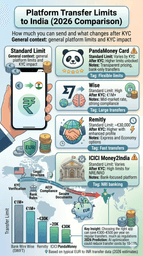
The general pattern: the more you verify upfront, the higher your transfer limits become. Completing Enhanced KYC and uploading proof of identity, address, and, for large amounts, source of funds is always worth doing in advance if you plan to send significant sums.
Platforms including PandaMoney (getpanda.money) let you complete this in the app, available on Android and iOS. What really separates platforms isn’t just limits; this is why the exchange rate matters more than the fee.
Large Transfer Limits to India from Europe: What to Do Above €10,000
Transfer limits to India from Europe do not cap how much you can send, but amounts above €10,000 require additional checks and preparation. Here’s how to handle large transfers smoothly.
European Side Requirements for Large Transfers
For transfers above €10,000, your bank or platform will request source-of-funds documents. This usually includes payslips, bank statements, tax returns, or proof of asset sale.
Submitting clear documents quickly helps avoid delays. Most transfer holds happen due to missing or incomplete information.
Indian Side Compliance Under FEMA
On arrival, Indian banks may ask for purpose-related documentation. For property or investment transfers, Form 15CA and Form 15CB may be required to confirm tax compliance.
For family maintenance or gifts, these forms are usually not needed.
Example: Sending €20,000 to India
For a €20,000 transfer from Europe to India, ensure the recipient uses an NRO account for property-related payments. Keep your income proof ready and respond quickly to verification requests.
The receiving bank will issue an e-FIRC as proof of transfer. With proper documentation, most large transfers are completed within 1 to 2 business days.
Do You Need to Pay Tax When Sending Money to India from Europe?
The short answer: most personal remittances from Europe to India attract no tax for the recipient in India, and there is generally no European tax on the act of sending money abroad. But there are important nuances.
In India, what is and isn’t taxable:
| What You’re Sending | Tax in India |
|---|---|
| Family maintenance, living expenses | Not taxable |
| Gift to a “relative” (as defined by Income Tax Act) | Not taxable, any amount |
| Gift to a non-relative | Taxable if above ₹50,000/year |
| Education or medical expense payments | Not taxable |
| Salary or business income | Taxable as per income slab |
| NRE account interest | Fully exempt (Section 10(4)(ii), Income Tax Act, 1961) |
| NRO account interest | 30% TDS (reducible via DTAA) |
India has active Double Taxation Avoidance Agreements (DTAs) with virtually every major European country — including Germany, France, the Netherlands, Belgium, Italy, Spain, Sweden, and Austria. Under these treaties, NRO account interest taxed at 30% TDS in India can be reduced to as low as 10–15% if your family member submits a Tax Residency Certificate (TRC) from their country of residence to their Indian bank.
In Europe — no tax on the transfer itself:
EU countries do not impose tax simply on sending money abroad. However, if the money represents income you’ve already earned and paid local tax on, you have no additional tax obligation. For transfers from savings or investment proceeds, relevant capital gains or income tax rules of your EU country of residence may apply to the gains themselves — not to the act of sending — before remitting. Consult a qualified accountant for your specific situation.
This section is for informational purposes only. Always consult a qualified CA or tax adviser for advice specific to your situation.
How to Send EUR to India from Europe Without Delays
Sending money from Europe to India is straightforward when you follow the right steps. Here’s a clear process to complete your transfer smoothly and stay compliant with transfer limits to India from Europe.
Step 1: Access the Platform
Download PandaMoney on Android or iOS, or visit getpanda.money
Step 2: Complete KYC Verification
Upload your passport or EU national ID along with proof of address. For larger transfers, keep source-of-funds documents ready.
Step 3: Link Your Bank Account
Connect your EU bank account as the funding source. Transfers use IBAN, and PandaMoney supports all major European banking networks.
Step 4: Add Recipient Details
Select India and enter your recipient’s bank account number and IFSC code. The recipient does not need a PandaMoney account.
Step 5: Review Costs Before Sending
Check the exchange rate, transfer fee, and exact INR amount your recipient will receive. PandaMoney currently offers zero transfer fees during its launch period.
Step 6: Confirm and Track the Transfer
Confirm the transaction and track it in real time. Most transfers are completed within minutes to a few hours, while larger transfers may take up to one business day.
How PandaMoney Enables Faster Transfers
PandaMoney uses USD-backed stablecoins such as USDC and USDT for settlement. This reduces costs and speeds up transfers without requiring the recipient to interact with crypto.
To understand this in detail, refer to how stablecoin rails keep transfer costs low.
Frequently Asked Questions
Is there a legal limit on how much money can be sent to India from Europe?
There is no fixed upper limit on personal transfers. You can send €500 or €500,000. Transfers above €10,000 usually trigger enhanced checks under EU AML rules. India’s FEMA also has no cap, but requires authorised channels and a purpose code.
What documents are required for large transfers from Europe?
For amounts above €10,000, expect identity proof, address proof, and source-of-funds documents such as payslips, bank statements, or tax returns. In India, certain transactions may require Form 15CA and 15CB. Routine family transfers usually need minimal documentation.
Does the recipient in India pay tax on money received?
Most transfers are not taxable. Gifts to relatives are fully exempt. Gifts from non-relatives above ₹50,000 per year are fully taxable. NRO account interest is taxed at 30%, but DTAA can reduce it to 10–15%.
Does the EU €10,000 rule affect transfers to India?
No. The €10,000 limit applies to cash transactions within the EU, not digital transfers. There is no cap on online transfers to India. Above €10,000, only additional verification applies.
Does the recipient need a Transfer App account?
No. The recipient only needs a bank account and an IFSC code. Money is credited directly, usually within minutes to 24 hours, depending on the platform.
What is the cheapest way to send EUR to India?
The cheapest transfers combine low or zero fees + near mid-market rates. Platforms like PandaMoney offer €0 fees, while Wise charges low fees. Banks typically charge €20–€50 + 2–4% markup, costing ₹4,000–₹8,000 more per €1,000.
What is FEMA, and how does it affect transfers?
FEMA is India’s foreign exchange law enforced by the RBI. It requires all transfers to go through authorised channels, include a purpose code, and maintain records for 5 years. Violations can attract penalties of up to 3x the transfer amount.
Final Thoughts
Sending money to India from European countries comes with no hard upper limit for most personal transfers. What matters is using the right channels, declaring the correct purpose, and keeping documentation ready for larger amounts. Understanding EU AML requirements and India’s FEMA rules keeps your transfers smooth and compliant.
For most NRIs in Germany, France, the Netherlands, Belgium, Spain, and across the EU, the process is simple. Use a licensed platform, complete KYC in advance, and your family receives INR directly in their bank account, often within minutes to a few hours.
Download PandaMoney on Android or iOS, or visit getpanda.money to start your transfer. All fees and the live exchange rate are shown before you confirm — no surprises, no hidden markup, no unnecessary delays.
This blog is for informational purposes only and does not constitute legal, financial, or tax advice. Regulations, fees, and exchange rates change frequently. Always consult a qualified CA or financial adviser for guidance specific to your situation. PandaMoney is a fintech platform, not a bank, and operates through regulated institution partners.
Verify current RBI guidelines at rbi.org.in and EU AML requirements with your national regulator.
External references: RBI official site · India Income Tax Department · World Bank remittance data





GetPandaMoney Inc. is a financial technology company, not a bank. Our product and services are offered in partnership with regulated and licensed financial institutions in each jurisdiction that we operate in. Client(s) deal directly with our regulated partners through the platform provided by PandaMoney.
For any queries or grievances, please write to us at compliance@getpanda.money
131 Continental Dr Suite 305 Newark, DE, 19713 US
©2025 PandaMoney. All Rights Reserved.
GetPandaMoney Inc. is a financial technology company, not a bank. Our product and services are offered in partnership with regulated and licensed financial institutions in each jurisdiction that we operate in. Client(s) deal directly with our regulated partners through the platform provided by PandaMoney.
For any queries or grievances, please write to us at compliance@getpanda.money
131 Continental Dr Suite 305 Newark, DE, 19713 US
©2025 PandaMoney. All Rights Reserved.