


SWIFT vs Stablecoin Transfer to India: Which Is Faster and Cheaper?
 Panda AI
If you send money to India regularly, you have probably used a SWIFT transfer without giving it much thought. It is the default method at most banks, and it works. However, it is slow and expensive in ways that are easy to miss.
Stablecoin transfers, on the other hand, are newer, faster, and significantly cheaper. Still, many NRIs are not sure what they are or whether they are safe.
This guide breaks down SWIFT vs stablecoin transfer to India: how each one works, what each one costs, and which one makes more sense for NRIs sending money home in 2026.
What Is a SWIFT Transfer to India
SWIFT is a global messaging network that banks use to send payment instructions to each other. It stands for the Society for Worldwide Interbank Financial Telecommunication and has been around since 1973.
Here is the key thing to understand: SWIFT does not move money directly. It sends a message from your bank to the recipient’s bank saying, “Please pay this person.” The actual money moves through a chain of correspondent banks that have agreements with each other.
Think of it like a relay race. Your bank passes the baton to a correspondent bank, which passes it to another, which eventually reaches your recipient’s Indian bank. Every runner in that race takes a cut before passing it on.
A typical SWIFT transfer to India from the US goes like this:
- Your US bank sends a SWIFT message
- A large correspondent bank (like JPMorgan or Citibank) picks it up and forwards it
- That bank routes it to its Indian banking partner
- The Indian bank credits your recipient’s account
Each step in that chain takes time. Each bank in the chain also charges a fee. By the time the money arrives, your recipient may receive less than you sent, with no clear explanation of where the rest went.
What Is a Stablecoin Transfer to India
A stablecoin is a type of digital currency that maintains a fixed value. USDC and USDT, the two most widely used stablecoins, each hold a 1:1 peg to the US dollar. That means 1 USDC always equals $1. There is no price volatility like Bitcoin or Ethereum.
When you send money through a stablecoin-powered platform like PandaMoney, here is what actually happens:
- You send dollars from your overseas bank account
- The platform converts them to USDC on the blockchain
- USDC moves across the blockchain in minutes
- The platform converts back to INR through regulated banking partners in India
- Rupees land in your recipient’s Indian bank account
You will never touch a crypto wallet, and you do not need to understand blockchain. You just send money like you normally would, and it arrives faster and at a lower cost. The experience looks and feels exactly like any other transfer app.
Understanding the Speed Comparison
Speed is where the SWIFT vs stablecoin transfer to India difference is most obvious.
How Long SWIFT Transfers to India Actually Take
A SWIFT transfer to India from the US, UK, or Europe typically takes 3 to 5 business days. That delay comes from:
- Processing time at your sending bank (often next business day)
- Correspondent bank processing (another 1 to 2 days)
- Cut-off times: miss your bank’s daily cut-off by minutes, and the whole clock resets
- Public holidays in either country pause the chain completely
- Compliance checks at each bank can add further delays if anything flags
In practice, many NRIs have experienced SWIFT transfers taking 6 to 7 days during busy holiday periods or when additional compliance checks get triggered at one of the banks in the chain.
How Long Do Stablecoin Transfers to India Take
Stablecoin-powered platforms like PandaMoney deliver transfers to Indian bank accounts the same day or the next business day. The blockchain settlement happens in minutes. The remaining time is for banking processes on the Indian side.
There are no correspondent banks. No cut-off times to miss. No chain of institutions that each need to process the message in sequence.

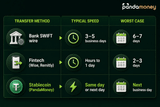
For an NRI funding a home loan, property payment, or emergency family support, the speed difference is not just convenient. It is financially and practically important.
Understanding the Cost Comparison
Cost is where the SWIFT vs stablecoin transfer to India gap becomes most significant for NRIs.
The Real Cost of a SWIFT Transfer to India
SWIFT transfer costs have two components. Most NRIs only notice the first one.
Visible costs:
- Sending bank wire fee: $25 to $50
- Correspondent bank fee: $15 to $30, silently deducted from the transfer amount
- Receiving bank fee: $5 to $15 charged on the Indian side
Hidden cost:
- Exchange rate markup: 2% to 3.5% applied by your bank on the dollar-to-rupee conversion
Your bank offers you a rate that sits below the real mid-market rate (the one you see on Google) and keeps the difference. They never label it as a fee.
On a $5,000 SWIFT transfer to India:
| Cost Component | Amount |
|---|---|
| Sending bank wire fee | $40 |
| Correspondent bank fee | $25 |
| Exchange rate markup at 2.5% | $125 |
| Receiving bank fee | $10 |
| Total cost | ~$200 |
That is 4% of your transfer gone before rupees land.
The Real Cost of a Stablecoin Transfer to India
Stablecoin-powered platforms bypass the SWIFT network and the correspondent banking chain. There are no correspondent fees. There is no exchange rate markup built into the rate.
PandaMoney charges zero transfer fees during the current launch offer and delivers at the real mid-market rate. On that same $5,000 transfer, the total cost is zero.
Over a year, an NRI sending $2,000 per month via bank SWIFT wire loses approximately:
- Exchange rate markup at 2.5%: $600 per year
- Wire fees at $40 per transfer: $480 per year
- Total annual loss: over $1,000
Switching to a stablecoin-powered platform eliminates that cost entirely. For an NRI with a 20-year home loan or ongoing family support commitments, that saving compounds significantly over time.
To understand how stablecoin rails make this cost structure possible, where SWIFT cannot, that article explains the infrastructure difference clearly.
Understanding Safety and Compliance
This is the question most NRIs ask first. Is a stablecoin transfer to India actually safe and legal?
Is SWIFT Transfer to India Safe
Yes. SWIFT is the most established international transfer network in the world. Your bank handles the compliance, the documentation, and the regulatory reporting. Every transfer creates a clear paper trail.
The downside is not safety. It is cost and speed.
Is Stablecoin Transfer to India Safe and Legal
Yes, provided you use a regulated platform like PandaMoney that handles all the complexity on the back end.
How PandaMoney keeps stablecoin transfers safe and compliant:
- Operates through regulated banking partners in India, authorised by the RBI
- Every transfer creates a documented inward remittance record that satisfies FEMA requirements
- Transfers credit directly to your NRE or NRO bank account in India
- You never hold stablecoins or manage a crypto wallet
- Full KYC and AML verification on every user and transaction
The stablecoin layer is infrastructure, not exposure. You send dollars. Your family receives rupees. The blockchain settlement happens in the background, managed entirely by the platform. The experience on your end is identical to any other modern transfer app.
For a guide on how to send money from the US to India safely with proper documentation, the walkthrough covers the compliance steps that matter.

How PandaMoney Makes Stablecoin Transfer to India Simple
The SWIFT vs stablecoin transfer to India comparison is clear on paper. PandaMoney makes it just as simple in practice.
You download the app, complete a quick KYC verification, and enter your recipient’s Indian bank account details. You send in dollars, euros, or pounds. Rupees arrive in the Indian account the same day or next business day at the real mid-market rate with no fees. The whole setup takes a few minutes on your first transfer.
Every transfer also delivers:
- A clean inward remittance record for your Indian bank and CA
- FEMA-compliant documentation for property purchases, NRE account funding, and repatriation
- Full transaction history accessible in the app
For NRIs in the US, the guide on IRS reporting thresholds and documentation for large transfers to India is worth reading before sending larger amounts.
Download PandaMoney on Android or iOS.
FAQs: SWIFT vs Stablecoin Transfer to India
Do I Need to Understand Crypto to Use a Stablecoin Transfer to India?
No. Platforms like PandaMoney handle the entire stablecoin process in the background. You send money exactly as you would with any other app: enter the amount, enter the recipient’s bank details, and confirm. You never see, touch, or manage any cryptocurrency.
Is a Stablecoin Transfer to India Legal Under FEMA?
Yes. PandaMoney routes transfers through RBI-authorised banking partners in India. Every transfer creates a formal inward remittance record and is credited directly to an Indian NRE or NRO account. This satisfies FEMA requirements fully. The stablecoin layer is an internal settlement mechanism, not a cross-border crypto transaction.
Which Is Better for Large Transfers: SWIFT or Stablecoin?
For large transfers, the stablecoin advantage grows. A $20,000 transfer via SWIFT at a 2.5% markup costs you $500 in hidden exchange rate losses before any fees. The same transfer via PandaMoney costs zero. The FEMA documentation is equally strong on both methods, so there is no compliance advantage to using SWIFT for large amounts.
Can I Send to Any Indian Bank Account via Stablecoin Transfer?
Yes. PandaMoney transfers credit to any standard Indian bank account, including NRE and NRO accounts at all major banks such as HDFC, ICICI, SBI, Axis, and Kotak. The recipient does not need to do anything differently to receive the funds.
Why Do Banks Still Use SWIFT If Stablecoin Is Faster and Cheaper?
Banks built their international transfer infrastructure around SWIFT decades ago. Switching requires significant technical investment, regulatory approvals in multiple jurisdictions, and new banking partnerships. Banks also earn substantial revenue from exchange rate markups on SWIFT transfers, which creates very little incentive to move to a faster, cheaper model. Fintech platforms built on stablecoin rails have no legacy infrastructure to maintain and no markup revenue to protect, which is why they can offer better speed and zero cost.
Disclaimer: This blog is for educational purposes only and does not constitute financial or legal advice. Transfer fees, exchange rates, and platform features change frequently. Always verify current rates and fees directly with your chosen platform before sending. Verify RBI guidelines on inward remittances at rbi.org.in.
Related Articles





GetPandaMoney Inc. is a financial technology company, not a bank. Our product and services are offered in partnership with regulated and licensed financial institutions in each jurisdiction that we operate in. Client(s) deal directly with our regulated partners through the platform provided by PandaMoney.
For any queries or grievances, please write to us at compliance@getpanda.money
131 Continental Dr Suite 305 Newark, DE, 19713 US
©2025 PandaMoney. All Rights Reserved.
GetPandaMoney Inc. is a financial technology company, not a bank. Our product and services are offered in partnership with regulated and licensed financial institutions in each jurisdiction that we operate in. Client(s) deal directly with our regulated partners through the platform provided by PandaMoney.
For any queries or grievances, please write to us at compliance@getpanda.money
131 Continental Dr Suite 305 Newark, DE, 19713 US
©2025 PandaMoney. All Rights Reserved.