


Send Money to India from USA: Government Rules Explained (2026)
 Panda AI
Every year, Indian-Americans send over $32 billion to India. Every single one of those transfers sits at the intersection of two governments, two sets of laws, and a web of financial regulations. Most senders never fully understand what those rules require.
That lack of awareness has a real cost. Transfers that violate US reporting rules can trigger IRS scrutiny. Transfers that use the wrong Indian bank channel can expose your recipient to FEMA penalties. The good news is that, for routine personal remittances, following the rules is straightforward once you know what they are.
This guide covers every major government regulation that applies when you send money to India from the USA. We cite the official source for each rule, explain it in plain language, and show you how PandaMoney handles compliance automatically so you can transfer with confidence.
Is It Legal to Send Money to India from the USA?
Yes. Sending money to India from the USA is completely legal. No US law restricts outbound transfers to India, and no Indian law limits how much family support a recipient can receive from abroad.
What the law requires is that you use regulated channels, declare the correct transfer purpose, report large amounts to the IRS where applicable, and avoid prohibited funding sources. Use a licensed, compliant platform, and these requirements are largely handled for you.
Part 1: US Government Regulations (Sending Side)

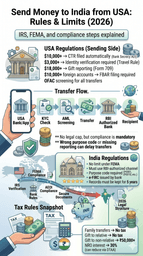
When you send money from the USA to India, US federal law governs the transaction. These are the five key regulatory frameworks you need to know.
1. The Bank Secrecy Act and Currency Transaction Reports Above $10,000
Source: Financial Crimes Enforcement Network (FinCEN) — Bank Secrecy Act, 31 U.S.C. § 5313
Any single cash transaction exceeding $10,000 triggers a Currency Transaction Report (CTR), which your financial institution files automatically with FinCEN. You do not need to take any action yourself.
However, you must never attempt to “structure” transfers to stay below the $10,000 threshold. Making three $9,500 transfers instead of one $28,500 transfer constitutes structuring, which is a federal crime under 31 U.S.C. § 5324, regardless of whether your funds are legitimate.
For most NRIs sending routine amounts for family expenses, the BSA has no practical impact. It is a reporting rule for financial institutions, not a cap on what you can send.
2. The Travel Rule: Identity Verification Above $3,000
Source: FinCEN Travel Rule, 31 CFR § 1010.410
All US money transfer operators must collect and retain the identity information of senders for transfers of $3,000 or more. This includes the sender’s name, address, account number, and the recipient’s details.
This is why PandaMoney requires identity verification during sign-up. It is a legal requirement, not a preference. Completing KYC verification also protects you by creating a clean audit trail that proves your transfer was legitimate.
3. IRS Gift Tax and the Annual Gift Exclusion
Source: IRS Form 709; IRC § 2503
US citizens and residents can give up to $18,000 per recipient per year (2024 limit) without any gift tax filing obligation. This is the Annual Gift Tax Exclusion. If you give more than $18,000 to any single individual in a calendar year, you must file IRS Form 709, though you will typically owe no actual tax unless your lifetime giving exceeds $13.61 million.
Most NRIs sending money for family maintenance are not sending gifts in the legal sense. Money sent for a dependent’s food, medical care, housing, or education is generally not subject to gift tax at all. However, if you are sending a cash gift above $18,000 per person in a year, be aware of the Form 709 filing obligation.
4. FATCA: Foreign Account Tax Compliance Act
Source: IRS FATCA — IRC §§ 1471-1474
FATCA requires US persons to report foreign financial accounts and assets above certain thresholds. Two reporting requirements apply here.
FBAR (FinCEN Form 114): If your foreign bank accounts, including Indian NRE or NRO accounts, held a combined balance exceeding $10,000 at any point during the year, you must file an annual Foreign Bank Account Report with FinCEN by April 15.
IRS Form 8938: If foreign financial assets exceed $50,000 on the last day of the year, you must also file this form with your federal tax return.
Penalties for non-filing are severe, up to $10,000 per violation for FBAR and up to $50,000 for willful violations. Note that sending money to India does not itself trigger FATCA. Holding foreign accounts above the thresholds does.
5. OFAC Sanctions: You Cannot Send to Sanctioned Entities
Source: US Treasury OFAC
The US Treasury’s Office of Foreign Assets Control (OFAC) maintains a list of Specially Designated Nationals (SDN). US persons cannot conduct financial transactions with anyone on this list. For virtually all NRIs sending money to family in India for personal purposes, OFAC is irrelevant. India is not a sanctioned country. However, every licensed platform, including PandaMoney, screens all transactions against the SDN list as part of its AML compliance program.
Part 2: Indian Government Regulations (Receiving Side)
Once your money crosses into India, it enters the jurisdiction of the Reserve Bank of India (RBI) and the Foreign Exchange Management Act. Here is what governs your recipient’s end of the transfer.
6. FEMA 1999: India’s Master Law for Foreign Exchange
Source: Foreign Exchange Management Act, 1999 — Ministry of Finance, Government of India
The Foreign Exchange Management Act (FEMA), administered by the RBI, governs all foreign exchange transactions entering and leaving India. All inward remittances from NRIs in the USA are regulated under FEMA.
FEMA does not restrict how much money your family can receive from you abroad for personal purposes. What it requires is that the money arrives through RBI-authorized channels and that the correct purpose code is declared on the transfer. Penalties for unauthorized transactions under Section 13 of FEMA can reach up to three times the amount involved.
7. RBI Purpose Codes: Mandatory for Every Transfer
Source: RBI Purpose Code Directory — FEMA 23(R)
Every inward remittance to India must carry an RBI-assigned purpose code that declares why the money is being sent. This code is attached to the transfer at the payment instruction level and reported by the receiving bank to the RBI.
| RBI Purpose Code | Transfer Purpose |
|---|---|
| P0001 | Family maintenance / living expenses |
| P0010 | Education fees or expenses |
| P1306 | Gift to a family member |
| P1301 | Rental income remittance |
| P0803 | IT services / software consultancy |
When you initiate a transfer, your platform will ask for a transfer purpose. Select the correct one. Incorrect purpose codes can delay your transfer or cause the receiving bank to reject the funds. When in doubt, “family maintenance” (P0001) is the right choice for general family support.
8. e-FIRC: Foreign Inward Remittance Certificate
Source: RBI Circular on FIRC Issuance, FEMA Notification No. FEMA 3/2000-RB
When foreign money arrives in an Indian bank account, the receiving bank issues a Foreign Inward Remittance Certificate (e-FIRC) as official proof of receipt. Your recipient’s bank issues this automatically for each qualifying transfer. No separate request is needed.
Your recipient may need the e-FIRC for property purchases, income tax filings, or freelance income documentation. FEMA requires it to be retained for a minimum of 5 years.
Part 3: Tax Regulations on Both Sides
Understanding the tax implications of sending money to India is a distinct question from understanding the transfer regulations. However, they are closely connected.
Is Money Received from the USA Taxable in India?
Source: Income Tax Act, 1961, Section 56(2)(x)
Most personal remittances are not taxable in India.
| Type of Transfer | India Tax Treatment |
|---|---|
| Money sent to parents, spouse, or children for living expenses | Not taxable — treated as family maintenance |
| Gift to a “relative” as defined under Section 56(2)(x) | Not taxable, any amount, from any relative |
| Gift to a non-relative above Rs.50,000/year | Taxable under “Income from Other Sources” |
| Salary or business income remitted from USA | Taxable in India if recipient is a resident |
“Relative” under the Income Tax Act covers spouse, siblings, siblings of spouse, siblings of parents, and direct lineal ascendants or descendants. Always consult a qualified Chartered Accountant (CA) for guidance specific to your situation.
Is Sending Money to India Taxable in the USA?
Sending money abroad is generally not a taxable event for the sender. You are sending your after-tax money. However, gifts above $18,000 per recipient per year require a Form 709 filing, even if no actual tax is owed. Money sent as a business payment to a contractor in India is a deductible business expense under normal US tax rules.
The India-USA Double Taxation Avoidance Agreement (DTAA)
Source: India-USA DTAA, in force since 1990
The India-USA DTAA prevents the same income from being taxed in both countries. The most practical benefit for NRIs is on the NRO account interest. The standard Indian TDS rate on NRO interest is 30%. Under the DTAA, eligible US residents can reduce this to 15% by submitting a Tax Residency Certificate (IRS Form 6166) to their Indian bank annually.
When Do You Need Form 15CA and Form 15CB?
Source: Section 195, Income Tax Act, 1961
| Form | What It Is | When Required |
|---|---|---|
| Form 15CB | CA certificate confirming tax compliance | Taxable remittances above prescribed thresholds |
| Form 15CA | Online declaration of tax compliance | Filed after Form 15CB, before the transfer |
| Neither required | Routine family maintenance, education, medical | Transfers under Rs.5 lakh for personal purposes |
For ordinary family support transfers under Rs. .5 lakh, you do not need these forms at all.
How PandaMoney Keeps Every Transfer Fully Compliant
PandaMoney was built with compliance at its core. Here is how the platform handles each regulatory layer automatically.
KYC at sign-up: Every PandaMoney account requires identity verification in compliance with the Travel Rule, FinCEN requirements, and India’s KYC norms. You verify once, and it covers all future transfers.
AML screening: Every transfer is screened against OFAC’s SDN list, FATF risk databases, and international AML watchlists before processing.
Licensed institution partners: All PandaMoney transfers route through RBI-licensed Authorized Dealer partners on the Indian side. This ensures FEMA compliance by default, and your recipient’s funds arrive with a proper e-FIRC.
Purpose code routing: PandaMoney captures the transfer purpose during the transfer flow, enabling correct RBI purpose code assignment every time.
Stablecoin rails with full traceability: PandaMoney uses USD-backed stablecoins, USDC and USDT, for settlement. Every transaction generates a blockchain transaction hash that creates a tamper-proof audit trail. Your recipient in India receives standard INR directly in their bank account. No crypto wallet required on their end.
Download PandaMoney on Android or iOS, or visit getpanda.money to start a fully compliant transfer today.
Regulation Quick-Reference Table
| Regulation | Jurisdiction | Threshold | Action Required | Official Source |
|---|---|---|---|---|
| Bank Secrecy Act / CTR | USA (FinCEN) | Cash transactions above $10,000 | Filed by your bank automatically | fincen.gov |
| Travel Rule | USA (FinCEN) | Transfers above $3,000 | KYC verification at sign-up | fincen.gov |
| IRS Gift Tax / Form 709 | USA (IRS) | Gifts above $18,000/year per recipient | File Form 709 (usually no tax owed) | irs.gov |
| FBAR (FinCEN Form 114) | USA (FinCEN) | Foreign accounts above $10,000 any time | Annual FBAR filing by April 15 | fincen.gov/fbar |
| FATCA (Form 8938) | USA (IRS) | Foreign assets above $50,000 | File Form 8938 with tax return | irs.gov/fatca |
| OFAC Sanctions | USA (Treasury) | Any transaction with SDN-listed entity | Blocked by your platform automatically | ofac.treasury.gov |
| FEMA 1999 | India (RBI) | All inward remittances | Use AD bank channel; declare purpose | rbi.org.in |
| RBI Purpose Codes | India (RBI) | Every transfer | Declare correct purpose code | rbi.org.in |
| e-FIRC | India (RBI) | Every inward remittance | Issued by recipient’s bank; retain 5 years | rbi.org.in |
| India-USA DTAA | India / USA | NRO account interest | Submit TRC to Indian bank | mea.gov.in |
| Section 56(2)(x) IT Act | India (CBDT) | Gifts above Rs.50,000/year from non-relative | Taxable as income in recipient’s hands | incometax.gov.in |
Frequently Asked Questions
Do I need to inform the IRS every time I send money to India?
No, you do not need to separately notify the IRS for each transfer. However, you must file IRS Form 709 if you give more than $18,000 as a gift to any single person in a calendar year. If you hold foreign accounts, including an NRE or NRO account in India, with a combined balance that exceeded $10,000 at any point during the year, you must also file an annual FBAR with FinCEN. Routine family support payments generally do not trigger additional IRS reporting.
Is there a limit on how much money I can send to India from the USA?
No US law sets a maximum on outbound transfers, and no Indian law limits personal inward remittances for family support. However, transfers above $10,000 trigger automatic CTR reporting by your financial institution, and your recipient’s Indian bank may request additional documentation for large amounts. The Liberalised Remittance Scheme (LRS) is a limit on money going out of India, not money coming in.
What is FEMA, and how does it affect my transfer?
FEMA, the Foreign Exchange Management Act 1999, is the Indian law that governs all foreign money entering or leaving India. It requires that all inward transfers go through RBI-authorized bank channels, carry a correct purpose code, and originate from legitimate sources. For NRIs using a licensed platform like PandaMoney, FEMA compliance is handled automatically through regulated partner institutions.
What is an e-FIRC, and does my recipient need one?
An Indian bank issues an e-FIRC (electronic Foreign Inward Remittance Certificate) to confirm that foreign funds have been received. The RBI requires this document as proof of inward remittance under FEMA. The recipient’s bank issues it automatically for each qualifying transfer. Recipients may need it for property transactions, income tax filings, or freelance income documentation. FEMA requires recipients to retain it for at least five years.
Is it safe and legal to use a stablecoin platform like PandaMoney?
Yes. PandaMoney uses USD-backed stablecoins, USDC and USDT, as a settlement layer, but routes all transfers through licensed, RBI-authorized financial institution partners on the Indian side. Every transfer is fully FEMA-compliant, AML-screened, and KYC-verified. Recipients receive standard INR in their Indian bank accounts, with a proper e-FIRC issued by their bank. The stablecoin layer operates entirely behind the scenes for cost efficiency and speed.
This blog is for informational purposes only and does not constitute legal, financial, or tax advice. Regulations, reporting thresholds, and exchange rates change frequently.
Always verify current requirements with the relevant authority (FinCEN, IRS, RBI) or consult a qualified CA or tax advisor for guidance specific to your situation. PandaMoney is a fintech platform, not a bank, and operates through regulated and licensed institution partners. RBI and FEMA regulations are updated periodically. Verify current guidelines at rbi.org.in.





GetPandaMoney Inc. is a financial technology company, not a bank. Our product and services are offered in partnership with regulated and licensed financial institutions in each jurisdiction that we operate in. Client(s) deal directly with our regulated partners through the platform provided by PandaMoney.
For any queries or grievances, please write to us at compliance@getpanda.money
131 Continental Dr Suite 305 Newark, DE, 19713 US
©2025 PandaMoney. All Rights Reserved.
GetPandaMoney Inc. is a financial technology company, not a bank. Our product and services are offered in partnership with regulated and licensed financial institutions in each jurisdiction that we operate in. Client(s) deal directly with our regulated partners through the platform provided by PandaMoney.
For any queries or grievances, please write to us at compliance@getpanda.money
131 Continental Dr Suite 305 Newark, DE, 19713 US
©2025 PandaMoney. All Rights Reserved.