


IMPS vs NEFT vs RTGS: Which Payment Rail to Ask For
 Panda AI
This guide explains India’s three main domestic money transfer systems (IMPS, NEFT, and RTGS). It covers how each one works, how fast they are, how much they cost, when to use each, and which one to ask for when you are an NRI receiving money from abroad or moving money within your Indian bank accounts.
Every time money moves between bank accounts in India, it travels through one of three payment methods: NEFT, RTGS, or IMPS. If you have ever filled in a bank form or been asked “which transfer mode do you want?”, you have already encountered them. Most people pick one without really knowing the difference.
For NRIs, understanding these three systems matters. When money arrives from abroad into your NRE or NRO account, it moves within India using one of these rails. Knowing which to choose determines how fast your family gets the money and whether a transfer can happen on a Sunday night or has to wait until Monday morning.
What Are IMPS, NEFT, and RTGS?
All three are domestic Indian payment systems. They are entirely separate from international remittance channels like SWIFT or stablecoin-powered platforms like PandaMoney. They handle money movement inside India, between Indian bank accounts.
Here is the simplest way to understand each one:
- NEFT is like a train with scheduled departures. Your money joins the next batch and arrives within that window.
- RTGS is like a dedicated courier: instant, individual, and real-time. But it only takes large packages that are above INR 2 Lakhs.
- IMPS is like a motorbike courier: fast, available 24 hours, including all holidays, and handles small to large packages.
All three operate under the oversight of the Reserve Bank of India. IMPS is operated by NPCI (National Payments Corporation of India), an RBI-authorised organisation for retail payments.
Now, let us understand all of them in detail.
NEFT: National Electronic Funds Transfer
NEFT was introduced in 2003 by the RBI to replace paper-based payments with a standardised electronic system. It was India’s first widely adopted digital money transfer method for retail banking.
The key thing to understand about NEFT: it settles in batches, not instantly.
When you initiate a NEFT transfer, your instruction is queued and processed in a batch. The RBI processes NEFT transfers in half-hourly cycles, 24 hours a day, 7 days a week, including Sundays and public holidays. That means 48 settlement windows every day.
Your money could arrive within 30 minutes or take up to 1 hour, depending on when you sent it relative to the cycle. Send at 2:25 PM, the next batch might be at 2:30 PM, and the credit lands then. Miss a 2:30 PM cycle, and you wait until 3:00 PM.
How NEFT Works Step by Step
- Log in to your banking app and choose NEFT as the transfer mode
- Enter the recipient’s bank account number and IFSC code
- Your bank queues the instruction and sends it to the RBI in the next half-hourly batch
- The RBI settles all queued transactions in that batch at once
- The recipient’s bank receives the credit and updates the balance
NEFT at a Glance
- Speed: 30 minutes to 1 hour (batch-based)
- Minimum amount: ₹1 (no minimum)
- Maximum amount: No upper limit
- Available: 24/7, including Sundays and public holidays
- Fee: Free (the RBI removed NEFT charges for customers in 2019)
- Best for: Non-urgent transfers of any size
RTGS: Real Time Gross Settlement
RTGS was launched in 2004 and is India’s system for high-value transfers. It settles each transaction individually and in real time. Nothing is batched. Nothing waits.
“Real Time” means instant. When Bank A sends an RTGS instruction to Bank B, settlement happens in seconds. The recipient’s account is credited immediately.
“Gross Settlement” means each transfer settles one-by-one. Unlike NEFT, where the RBI processes hundreds of transactions together and settles the net difference, RTGS moves each rupee individually. This is why it is used for large amounts where precision and speed both matter.
The minimum amount is ₹2 lakh. You cannot use RTGS for small transfers. There is no upper limit.
RTGS went fully 24/7 in December 2020. Before that, it only operated during specific banking hours. Now you can use it at any time, including weekends and holidays.
When to Use RTGS in IMPS vs NEFT vs RTGS
RTGS is the right choice when:
- You are paying for a property purchase and need ₹50 lakh to arrive instantly
- A business contract requires a large verified payment with immediate confirmation
- You need to move ₹10 lakh between accounts and cannot afford any delay
IMPS: Immediate Payment Service
IMPS was launched in 2010 by NPCI and changed everything for Indian banking. For the first time, ordinary retail customers could transfer money instantly, at any time, even at midnight on a Sunday.
IMPS is instant and always available. Unlike NEFT’s batch processing and RTGS’s ₹2 lakh minimum, IMPS transfers money immediately and accepts any amount from ₹1 up to ₹5 lakh per transaction.
IMPS is also the backbone of India’s instant payment ecosystem. When you pay on PhonePe, Google Pay, or make a UPI transfer, the actual settlement underneath happens through IMPS infrastructure. UPI is essentially a user-friendly layer built on top of IMPS.
How IMPS Works Step by Step
You can initiate IMPS in two ways:
Method 1: Using account number and IFSC (most common) Open your banking app, choose IMPS, enter the recipient’s account number and IFSC code, enter the amount, and confirm with your MPIN or OTP. Money arrives in seconds.
Method 2: Using mobile number and MMID The recipient shares their registered mobile number and a 7-digit MMID (Mobile Money Identifier, generated by their bank when they register for mobile banking). You enter the mobile number, MMID, and amount. Transfer completes instantly.
Most people use Method 1 since the account number and IFSC are more widely familiar.
IMPS vs NEFT vs RTGS: Full Comparison

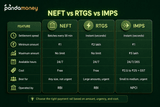
The simplest rule:
- Small or medium, not urgent → NEFT
- Large (₹2 lakh+), urgent → RTGS
- Any amount, urgent, anytime → IMPS
How IMPS vs NEFT vs RTGS Connects to NRI Remittances from Abroad
When PandaMoney sends your transfer from the US, UK, or Europe to India, the rupees arrive at your NRE or NRO account through international remittance rails. That international leg is completely separate from IMPS, NEFT, and RTGS.
Scenario 1: Urgent family support.
You send $2,000 via PandaMoney. Your parents receive the credit in their NRE account. They need to immediately move ₹60,000 to your sibling for a medical emergency. They use IMPS, which transfers it in seconds, even at 2 AM.
Scenario 2: Property payment installment.
Your NRE account has sufficient funds. You need to pay a property developer ₹25 lakh as an installment by the end of the day. Your bank uses RTGS, which credits the developer’s account in seconds.
Scenario 3: Monthly family maintenance.
You have set up a standing instruction to transfer ₹40,000 monthly from your NRO account to your parents’ savings account on the 5th. This uses NEFT, costs nothing, and works reliably every month within 30 to 60 minutes.
PandaMoney ensures every inward remittance creates a FEMA-compliant record through its network of 16+ fully authorised banking partners in India. That documentation matters when your family later uses RTGS for property payments or NEFT for regular monthly transfers, because the source of funds is clearly established from the start.
For NRIs who want to understand how to open an NRE account from the US, UK, or Europe to receive international remittances, this guide covers the full process. To understand the difference between NRE, NRO, and FCNR accounts and which type should receive your PandaMoney transfers, this comparison covers everything.
Download PandaMoney on Android or iOS.
FAQs: IMPS vs NEFT vs RTGS
What Is the Main Difference Between IMPS, NEFT, and RTGS?
NEFT transfers in scheduled batches every 30 minutes. RTGS transfers instantly for amounts above ₹2 lakh. IMPS transfers instantly for any amount up to ₹5 lakh at any time. NEFT and RTGS are free. IMPS has a small fee. All three are available 24/7.
Which Is Faster: IMPS or NEFT?
IMPS is faster. IMPS transfers settle in seconds and work at any hour. NEFT processes in batches every 30 minutes, so there can be a wait of up to 30 to 60 minutes, depending on when you send. For urgent transfers where you need the money to arrive immediately, IMPS is always the right choice.
Can I Use RTGS for Small Amounts Like ₹50,000?
No. RTGS has a minimum transfer amount of ₹2,00,000 (₹2 lakh). For amounts below ₹2 lakh, you must use NEFT or IMPS. Since IMPS is instant and also free up to most transaction amounts, it is the better choice for smaller urgent transfers.
Is IMPS Safe for Large Transfers?
Yes. IMPS is regulated by NPCI under RBI oversight. All transactions are encrypted and require authentication (MPIN or OTP). The per-transaction limit is ₹5 lakh, though some banks allow more for premium accounts. For transfers above ₹5 lakh, use RTGS instead. Both are equally secure.
Which Transfer Mode Does PandaMoney Use for India Remittances?
PandaMoney handles the international remittance leg, which is separate from IMPS, NEFT, and RTGS. The transfer travels from your overseas bank account through stablecoin rails (USDC/USDT) and arrives at your Indian NRE or NRO account through PandaMoney’s network of 16+ fully authorised banking partners. Once the rupees land in your Indian account, IMPS, NEFT, and RTGS are available for any further transfers within India, depending on urgency and amount.
Disclaimer: This blog is for educational purposes only. Banking regulations, transfer limits, and fee structures are subject to change by the RBI and NPCI. PandaMoney facilitates all international transfers exclusively through authorised and fully licensed banking and financial institution partners, ensuring full compliance with applicable RBI and FEMA guidelines. Verify current NEFT, RTGS, and IMPS guidelines at rbi.org.in and NPCI details at npci.org.in.
Related Articles





GetPandaMoney Inc. is a financial technology company, not a bank. Our product and services are offered in partnership with regulated and licensed financial institutions in each jurisdiction that we operate in. Client(s) deal directly with our regulated partners through the platform provided by PandaMoney.
For any queries or grievances, please write to us at compliance@getpanda.money
131 Continental Dr Suite 305 Newark, DE, 19713 US
©2025 PandaMoney. All Rights Reserved.
GetPandaMoney Inc. is a financial technology company, not a bank. Our product and services are offered in partnership with regulated and licensed financial institutions in each jurisdiction that we operate in. Client(s) deal directly with our regulated partners through the platform provided by PandaMoney.
For any queries or grievances, please write to us at compliance@getpanda.money
131 Continental Dr Suite 305 Newark, DE, 19713 US
©2025 PandaMoney. All Rights Reserved.