


10 Factors Impacting Currency Exchange Rates
 Panda AI
Currency exchange rates shift every single day. Economic data, central bank decisions, and political events all push rates up or down without warning. Every time you send money abroad, these movements decide how much your recipient actually receives.
This guide breaks down the 10 key factors that impact currency exchange rates in plain language. Understanding these drivers helps you plan smarter, time your transfers better, and get more value every time you send money internationally with PandaMoney.

What Is a Currency Exchange Rate?
A currency exchange rate tells you how much one currency is worth in terms of another. It determines how many rupees, pounds, or euros you receive when you exchange money. Every international payment, from family remittances to supplier invoices, depends directly on this rate.
Most major currencies, including the US dollar, the British pound, and the euro, operate on a floating system. This means their rates move freely based on market demand, economic data, and policy decisions. According to the Bank for International Settlements, the global foreign exchange market processes over $7.5 trillion in daily transactions, making it the largest financial market in the world.
The core engine behind every rate movement is supply and demand. When investors buy more of a currency, its value rises. When demand drops, the currency weakens. Exports, imports, interest rates, and political events all feed into this cycle constantly.
Understanding and Analysing the Factors
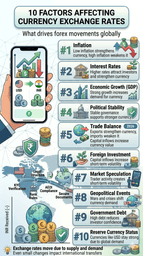
1. Inflation Rates
Inflation measures how quickly prices rise in a country. Low inflation keeps purchasing power stable and builds confidence in a currency. Investors trust that their returns will hold value, which increases demand and strengthens the exchange rate over time.
High inflation does the opposite. Money loses value faster, imports become expensive, and foreign investors reduce their exposure. This selling pressure weakens the currency steadily. A family sending 500 pounds home each month will receive fewer rupees when the destination currency is under inflationary pressure.
Tracking inflation data from sources like the Reserve Bank of India or the US Federal Reserve helps you anticipate rate movements before they affect your transfer. PandaMoney offers competitive rates that cushion the impact of these fluctuations on your transfers.
2. Interest Rates Set by Central Banks
Central bank interest rate decisions are among the most powerful short-term drivers of exchange rates. Higher interest rates attract global investors seeking better returns on savings and bonds. This capital inflow increases demand for the currency and strengthens its value almost immediately after an announcement.
The RBI, the US Federal Reserve, and the European Central Bank all make rate decisions that move markets within hours. Even a 0.25 percent hike can trigger significant buying activity as traders position themselves for stronger yields.
For example, when the Federal Reserve raises rates, the US dollar typically gains value. Non-dollar users sending money during that period pay more for each dollar they buy. Monitoring central bank calendars from federalreserve.gov helps you choose better transfer windows.
3. Economic Growth and GDP Performance
Strong GDP growth signals a healthy economy. Rising employment, growing business activity, and higher incomes attract foreign investment and push currency values upward. International investors move capital into economies that show consistent expansion because the returns are more reliable.
Weak economic performance reverses this flow. Businesses slow down, unemployment rises, and money moves to safer markets. This capital flight reduces demand for the currency and lowers the exchange rate, which raises the cost of imports, foreign tuition fees, and supplier payments.
Fast-growing economies in Asia frequently see their currencies appreciate during expansion phases. Businesses importing goods from those regions pay more over time. Watching World Bank GDP data gives you a forward-looking view on rate direction.
4. Political Stability and Government Policies
Political stability creates predictability. Consistent laws, reliable tax policy, and steady governance make a country attractive for long-term investment. This steady demand for the local currency keeps exchange rates relatively stable and reduces sudden volatility.
Uncertainty pushes investors away. Elections with unclear outcomes, trade disputes, or sudden regulatory changes cause capital to exit quickly. The currency weakens as demand drops, and the cost of international payments rises for ordinary senders and businesses alike.
A surprise policy change can move exchange rates overnight before businesses have time to react. Staying informed about political events in both the sending and receiving countries helps you avoid poorly timed transfers. PandaMoney gives you the flexibility to act when conditions look favourable.
5. Trade Balance: Exports vs Imports
A trade surplus means a country exports more than it imports. Foreign buyers need the exporting country’s currency to purchase those goods, which creates consistent demand and supports a stronger exchange rate over time.
A trade deficit tells the opposite story. Heavy imports mean the domestic currency gets sold to buy foreign currencies. This sustained selling pressure weakens the exchange rate gradually and increases the price of fuel, electronics, and raw materials for businesses and consumers.
Germany’s strong export performance, for example, consistently supports the euro. Import-heavy economies tend to see gradual depreciation. Businesses making regular international payments should monitor trade balance data from sources like Eurostat to plan payments more effectively.
6. Foreign Investment and Capital Flows
Foreign direct investment and portfolio investment both bring capital into a country. Factories, startups, and stock market investments all increase demand for the local currency as investors convert their funds. This inflow strengthens the exchange rate and signals long-term confidence in the economy.
Capital outflows have the opposite effect. When investors withdraw funds due to better opportunities elsewhere or rising risk, selling pressure builds quickly. The currency weakens, exchange rate volatility increases, and international transfer rates shift unfavourably for senders.
A new technology hub attracting global firms can lift a currency steadily over months. Market panic can reverse that movement in days. Monitoring capital flow reports from central banks helps you understand which direction a currency is heading.
7. Market Speculation and Forex Trading Activity
Traders in the foreign exchange market often react to expectations rather than current facts. A rumour of a rate hike, an unexpected GDP report, or a central bank speech can trigger billions in buying or selling within seconds. These moves create short-term volatility that affects real-world transfer rates.
Large institutional trades can push a currency well above or below its fundamental value temporarily. For individual senders, this means the rate you see at 9 AM may look very different by noon on a volatile day.
Rumours of a rate hike can lift a currency before any decision is officially announced. Sending money during speculation-driven spikes can cost significantly more. Using PandaMoney’s live rate tracking helps you avoid paying extra during these short-term swings.
8. Geopolitical Events and Global Crises
Wars, pandemics, trade sanctions, and natural disasters interrupt normal market behaviour instantly. Investors move funds into safe-haven assets and currencies, causing sudden and sharp exchange rate shifts across global markets.
Safe-haven currencies like the US dollar and the Swiss franc typically strengthen during crises. Riskier currencies depreciate rapidly as capital exits. These movements increase the cost of international transfers, business payments, and education remittances for people on the ground.
During the COVID-19 pandemic, many emerging market currencies lost significant value while the dollar and franc strengthened. Families sending wages home received less as a result. Keeping track of global events and using PandaMoney for fast processing helps you react before conditions worsen.
9. Government Debt and Fiscal Policy
High government debt levels concern foreign investors. When a government borrows heavily, investors worry about inflation and the potential for currency devaluation over time. This concern reduces demand for the currency and puts downward pressure on the exchange rate.
Responsible fiscal management, on the other hand, builds investor confidence. Lower debt-to-GDP ratios signal that the economy is well managed and that the currency is less likely to depreciate sharply. Countries with strong fiscal positions tend to attract more foreign investment and maintain stronger currencies.
Monitoring government debt reports from the International Monetary Fund gives you a broader picture of long-term currency trends. This context is especially useful for businesses making recurring international payments over months or years.
10. Currency Reserve Status and Global Demand
Currencies held as global reserves, particularly the US dollar, benefit from structural demand that other currencies do not enjoy. Central banks, governments, and international institutions hold reserves in these currencies for trade settlement and stability, which creates baseline demand regardless of short-term economic conditions.
The dollar’s reserve status means it often strengthens during global uncertainty as institutions increase their dollar holdings. This structural advantage makes the dollar more resilient than most currencies during downturns and affects the cost of USD-based remittances for senders using other currencies.
Understanding this dynamic helps NRIs and expats anticipate dollar strength during volatile global periods. PandaMoney uses stablecoin rails backed by USD to offer consistent pricing and faster settlement, even when traditional transfer routes face delays.
How Exchange Rate Changes Affect Your International Transfers
Even a small shift in the exchange rate quietly reduces the amount your recipient receives. Knowing how these changes work helps you trade smarter and avoid losing money to poor timing.
Impact on Family Remittances
Rate differences directly affect the final payout your family receives. A slight depreciation in the exchange rate can reduce the payout on the same amount you send. Sending 500 pounds at a weak rate can deliver 15 to 20 pounds less, which matters a great deal when the money covers rent, bills, and daily needs.
Effect on Business Payments and Imports
Businesses feel exchange rate shifts even faster than individuals. Strong rates benefit exporters while weaker rates raise costs for importers. A 1 percent movement on a 10,000-pound supplier payment represents 100 pounds in additional cost, which compounds across multiple monthly payments and squeezes margins quickly.
The Importance of Transfer Timing
Timing your transfers around rate movements protects value. Sending during a short-term spike in your favour can add meaningful rupees to each transfer. PandaMoney shows you live rates before you confirm, so you can choose the moment that works best for you.
Why PandaMoney Helps You Get Better Value on Every Transfer
International money transfers should not cost you money through hidden markups or unfair exchange rates. PandaMoney focuses on transparent pricing so you always know exactly what your recipient receives before you confirm.
PandaMoney uses USD-backed stablecoin rails (USDC and USDT) to settle transfers faster and at lower cost than traditional wire transfer routes. Your recipient receives standard INR directly in their Indian bank account. No crypto wallet is needed on their end.
Every transfer through PandaMoney is fully compliant with FEMA regulations, screened against OFAC sanctions lists, and KYC-verified. You get fast processing, secure payments, and real-time tracking in one place. Download the app on Android or iOS at getpanda. money.
Frequently Asked Questions
What causes currency exchange rates to change daily?
Currency exchange rates change daily because of shifts in supply and demand across the global forex market. Interest rate decisions by central banks, economic data releases like GDP and inflation figures, geopolitical events, and large-scale trading activity all move rates throughout the day. The Bank for International Settlements estimates that over $7.5 trillion changes hands in the forex market every single day, which means even small news events can trigger noticeable rate movements within hours.
How do interest rates affect currency exchange rates?
When a central bank raises interest rates, it offers better returns to investors who hold that currency. Global capital flows toward higher-yield currencies, which increases demand and pushes the exchange rate upward. Conversely, a rate cut signals looser monetary policy, reduces the appeal of that currency, and typically causes it to weaken. Decisions by the US Federal Reserve, the RBI, and the European Central Bank carry the most influence in global forex markets.
Does inflation weaken a currency’s exchange rate?
Yes. High inflation erodes the purchasing power of a currency over time. Foreign investors reduce their exposure to high-inflation economies because their returns lose real value. This reduced demand puts sustained downward pressure on the exchange rate. Countries that maintain low and stable inflation, like Switzerland or Singapore, tend to have stronger and more stable currencies as a result.
How does political instability affect exchange rates?
Political instability creates uncertainty, which investors dislike intensely. When elections, policy changes, or social unrest introduce unpredictability, capital flows out of that country quickly. This sudden reduction in demand weakens the currency exchange rate sharply. Currencies in politically stable countries with consistent governance tend to hold their value better across market cycles.
How can I get a better exchange rate when sending money to India?
You get a better exchange rate by timing your transfer during favourable rate windows, using a platform with transparent pricing and no hidden markups, and avoiding bank wire transfers that apply wide spreads. PandaMoney shows live rates before you confirm your transfer, charges zero transfer fees during the launch offer, and settles in minutes using stablecoin rails. Monitoring central bank announcements and economic data releases also helps you identify better timing for larger transfers.
What is the safest way to send money internationally during exchange rate volatility?
The safest approach during volatile periods is to use a licensed, regulated platform with real-time rate visibility so you know exactly what your recipient receives. Avoid platforms that offer delayed processing, as rates can shift significantly between the time you initiate a transfer and when it settles. PandaMoney processes transfers in minutes through compliant stablecoin settlement, which reduces your exposure to rate swings during processing delays.
This blog is for informational purposes only and does not constitute financial or investment advice. Exchange rates change constantly. Always check live rates before initiating a transfer. PandaMoney is a fintech platform, not a bank, and operates through regulated institution partners.





GetPandaMoney Inc. is a financial technology company, not a bank. Our product and services are offered in partnership with regulated and licensed financial institutions in each jurisdiction that we operate in. Client(s) deal directly with our regulated partners through the platform provided by PandaMoney.
For any queries or grievances, please write to us at compliance@getpanda.money
131 Continental Dr Suite 305 Newark, DE, 19713 US
©2025 PandaMoney. All Rights Reserved.
GetPandaMoney Inc. is a financial technology company, not a bank. Our product and services are offered in partnership with regulated and licensed financial institutions in each jurisdiction that we operate in. Client(s) deal directly with our regulated partners through the platform provided by PandaMoney.
For any queries or grievances, please write to us at compliance@getpanda.money
131 Continental Dr Suite 305 Newark, DE, 19713 US
©2025 PandaMoney. All Rights Reserved.