


Converting a Resident Savings Account to NRO After Moving Abroad
 Panda AI
Moving abroad does not automatically close your Indian bank account. This guide walks through everything NRIs need to know about converting their resident savings account to an NRO after moving abroad, including why FEMA requires it, what happens if you ignore it, the simple steps to get it done, and what actually changes once the conversion is complete.
The month you move to the US, UK, or Germany, your Indian bank account is probably the last thing on your mind. Visas, accommodation, and a hundred other priorities take over.
But here is something most NRIs discover months later: the moment you become an NRI under FEMA, your resident savings account is no longer legally valid for your use. You need to convert it to an NRO account.
The conversion is not complicated. What is complicated is not knowing it needs to happen.
So let us look into it.
Does Your Savings Account Automatically Convert to NRO When You Move Abroad?
No. Indian banks do not monitor your residency status and trigger the conversion on your behalf. The responsibility lies entirely with you to inform your bank that your status has changed.
Under the Foreign Exchange Management Act (FEMA), you qualify as an NRI once you have stayed outside India for more than 182 days in a financial year, or are employed or have established a business abroad. When that happens, continuing to operate a resident savings account technically violates FEMA regulations.
Your bank will not automatically know. The account will continue functioning normally from a technical standpoint. However, any transactions you make through a resident account while being an NRI create compliance issues that can become serious problems later, particularly if you ever try to repatriate funds, sell property, or deal with tax queries.
What FEMA Actually Says About Converting Your Savings Account to NRO
The RBI’s guidelines under FEMA are explicit. When an Indian resident leaves the country for employment, business, or an uncertain duration, they must convert their resident savings account to NRO as soon as possible.
The words “as soon as possible” are intentional. The RBI does not specify a hard deadline of 30 or 60 days. However, most CA and legal advisors recommend initiating the conversion within three months of qualifying as an NRI.
Here is why the conversion matters:
- A resident savings account earns interest taxed at the resident Indian rate (lower slabs apply)
- An NRO account earns interest taxed at a flat TDS rate of 30% for NRIs
- Operating a resident account while earning as an NRI distorts your declared income and tax position
- If you later repatriate funds, the documentation must be proper and follow through. Funds in an incorrectly designated account create complications at that stage
For official reference, the RBI’s FEMA guidelines on NRI accounts cover the full framework.
What Happens If You Do Not Convert Your Savings Account to NRO
Ignoring the conversion is more common than most people admit. The account keeps working. Transactions go through. Nothing really happens immediately.
But the risk builds gradually and surfaces at the worst possible times. Here is what all can unfold for you.
Tax exposure
The lower TDS rate on a resident savings account does not apply to NRIs. If you earn interest or receive rental income through a resident account while being an NRI, the tax treatment is incorrect. This discrepancy can attract scrutiny when you file returns or when income tax authorities flag your account.
Repatriation complications
Repatriation means sending money from your Indian account back to your overseas bank account. Think of it as the reverse journey: money that came into India, going back out to where you live.
When you try to repatriate funds, your Indian bank checks the paperwork behind the money. If your account is still designated as a resident savings account, the bank cannot process the outward transfer. It does not carry the FEMA-compliant status that an NRO account holds. The bank will either reject the request or freeze the funds until you complete the re-designation first.
Large transaction risks
Banks perform periodic reviews and may flag or freeze a resident account if they identify the account holder as an NRI. This can happen during a large credit, a property transaction, or a compliance audit.
None of these scenarios is inevitable. But all of them are entirely avoidable with a simple process that takes less than two weeks to complete.
How to Convert Your Resident Savings Account to NRO?

Before we start, here is the good news.
Converting your resident savings account to NRO does not require closing and reopening your account. Your account number stays the same. Your balance stays the same. Your debit card and internet banking continue working. The bank simply redesignates the account type in their system.
Here are the steps to follow-
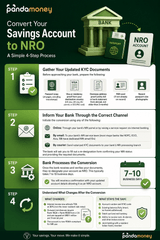
Step #1: Gather Your Updated KYC Documents
Before approaching your bank, prepare the following:
- Passport copy (all pages, including visa stamps)
- Visa or residency proof from your destination country (US visa, UK visa, EU permit, or OCI/PIO card)
- Overseas address proof (utility bill or bank statement from abroad, not older than 3 months)
- PAN card (if not already on record)
- Recent passport-size photographs
Step #2: Inform Your Bank Through the Correct Channel
Most major Indian banks have a dedicated NRI banking portal or NRI service desk. You can initiate the conversion:
- Online: Through your bank’s NRI portal or by raising a service request via internet banking
- By email: To your bank’s NRI service team (most major banks like HDFC, ICICI, Axis, SBI have dedicated NRI email IDs)
- By courier: Send notarized KYC documents to your bank’s NRI processing branch
The bank will ask you to fill out a re-designation form confirming your NRI status and providing the required documents.
Step #3: Bank Processes the Conversion
Once the bank receives and verifies your documents, they re-designate your account as NRO. This typically takes 7 to 10 business days. You will receive a confirmation with your updated account details showing it as an NRO account.
Step #4: Understand What Changes After the Convert Savings Account to an NRO Process
Your account remains operationally the same, but with updated rules:
What changes:
- Interest income now attracts TDS at 30% (not the lower resident slab rates)
- Outward remittances require Form 15CA + Form 15CB from a CA and are capped at USD 1 million per financial year
- The account is now FEMA-compliant for NRI use
What stays the same:
- Account number and IFSC code
- Existing balance (fully intact, no forced withdrawal)
- Debit card and net banking
- Ability to receive rent, dividends, and other Indian income
- Joint holding with a resident Indian family member
One Step NRIs Miss After Converting Savings Account to NRO
Converting your resident savings account to NRO is necessary. But it should not be your last move.
An NRO account holds Indian-sourced income and comes with repatriation limits. If you plan to send money from abroad to India, either for family support, property purchase, or savings, those funds should go into an NRE (Non-Resident External) account, not your NRO.
The key difference is repatriation:
- NRO account: Repatriation limited to USD 1 million per year with CA documentation
- NRE account: Fully and freely repatriable at any time, no cap, no forms
Most NRIs end up running both accounts side by side:
- NRO for Indian income (rental income, dividends, interest)
- NRE for overseas earnings that they remit to India
If you have not opened an NRE account yet, most major Indian banks allow you to open one completely online from abroad. For a full walkthrough of how to open an NRE account from the US, UK, or Europe, this guide covers the documents, steps, and which banks are easiest to work with.
For a complete comparison of NRE vs NRO vs FCNR accounts and which one suits your situation, the side-by-side covers every dimension.
Funding Your NRO or NRE Account After the Conversion
Once your accounts are in order, the next question is how to fund them efficiently from abroad.
Traditional bank wires into India apply a 2% to 3.5% exchange rate markup over the real mid-market rate, plus wire fees of $25 to $50. On a $5,000 transfer, that costs you up to $225 before rupees land.
PandaMoney routes transfers through stablecoin rails (USDC/USDT) instead of SWIFT, delivering rupees into your NRE or NRO account at the real mid-market rate with zero fees during the current launch offer. Every transfer also creates a clean FEMA-compliant inward remittance record, processed through PandaMoney’s network of 16+ fully authorised banking partners in India.
That documentation matters. When you later want to repatriate funds or use your NRO account as part of a property transaction, having a clear paper trail of how funds arrived in India protects your rights and speeds up every subsequent process.
Download PandaMoney on Android or iOS.
FAQs: Convert Savings Account to NRO
How Long Do I Have to Convert My Savings Account to NRO After Moving Abroad?
FEMA says “as soon as possible,” which most advisors interpret as within three months of qualifying as an NRI. There is no absolute statutory deadline. However, delaying the conversion while operating the account as a resident creates FEMA non-compliance and tax discrepancies that compound over time. Converting early avoids all of it.
Will My Balance Be Affected When I Convert My Savings Account to NRO?
No. Your existing balance transfers intact to the NRO account. There is no forced withdrawal, no closing and reopening, and no minimum balance requirement triggered by the conversion. The account number, IFSC code, and net banking credentials all stay the same.
Is There a Penalty for Not Converting a Resident Savings Account to NRO?
FEMA provides for penalties for contraventions, though enforcement for individual account holders is rare and typically reserved for deliberate or large-scale violations. The more practical risk is not a formal penalty but the downstream complications: incorrect TDS treatment, repatriation refusals, and documentation gaps that surface during property transactions or tax inquiries.
Can I Still Use My NRO Account to Pay Bills and Receive Rent in India?
Yes. An NRO account functions exactly like a resident savings account for domestic Indian purposes. You can receive rent, dividends, and other Indian income into it. You can pay bills, set up standing instructions for EMIs, and use the linked debit card for transactions in India. The main restriction is on repatriation, which requires CA documentation and is capped at USD 1 million per financial year.
Should I Convert to NRO or Just Open a New NRE Account?
Do both. Converting to NRO is a legal requirement for your existing account. Opening an NRE account is a strategic choice that gives you a fully repatriable account for overseas earnings you send to India. Most NRIs run both: NRO for Indian-sourced income, NRE for overseas remittances. The conversion and the NRE opening are separate actions, and both serve different purposes.
Disclaimer: This blog is for educational purposes only and does not constitute legal, financial, or tax advice. FEMA regulations and RBI guidelines are updated periodically. PandaMoney facilitates all transfers exclusively through authorised and fully licensed banking and financial institution partners, ensuring full compliance with applicable RBI and FEMA guidelines. Always consult a qualified Chartered Accountant before making accounting or tax decisions. Verify current FEMA and NRI account guidelines at rbi.org.in and tax rules at incometax.gov.in.
Related Articles





GetPandaMoney Inc. is a financial technology company, not a bank. Our product and services are offered in partnership with regulated and licensed financial institutions in each jurisdiction that we operate in. Client(s) deal directly with our regulated partners through the platform provided by PandaMoney.
For any queries or grievances, please write to us at compliance@getpanda.money
131 Continental Dr Suite 305 Newark, DE, 19713 US
©2025 PandaMoney. All Rights Reserved.
GetPandaMoney Inc. is a financial technology company, not a bank. Our product and services are offered in partnership with regulated and licensed financial institutions in each jurisdiction that we operate in. Client(s) deal directly with our regulated partners through the platform provided by PandaMoney.
For any queries or grievances, please write to us at compliance@getpanda.money
131 Continental Dr Suite 305 Newark, DE, 19713 US
©2025 PandaMoney. All Rights Reserved.